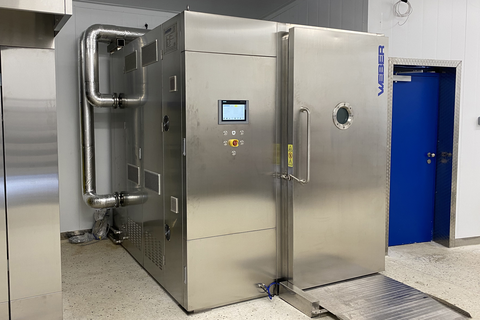
Vacuum cooling vs blast chilling: which is better for industrial food production?
For high-volume production of suitable cooked foods, vacuum cooling is usually the better industrial solution.
It can cool large batches in minutes, deliver a more consistent temperature throughout the product and reduce the amount of space required for cooling. This makes it particularly relevant for industrial kitchens, airline caterers, central production kitchens and ready-meal manufacturers.
Blast chilling remains a valuable and flexible technology. It is generally the more practical choice for liquids, sealed products and kitchens producing many small batches of different foods.
The real question is therefore not whether vacuum cooling is better in every situation. It is whether your products and production volumes can benefit from its much faster cooling process.

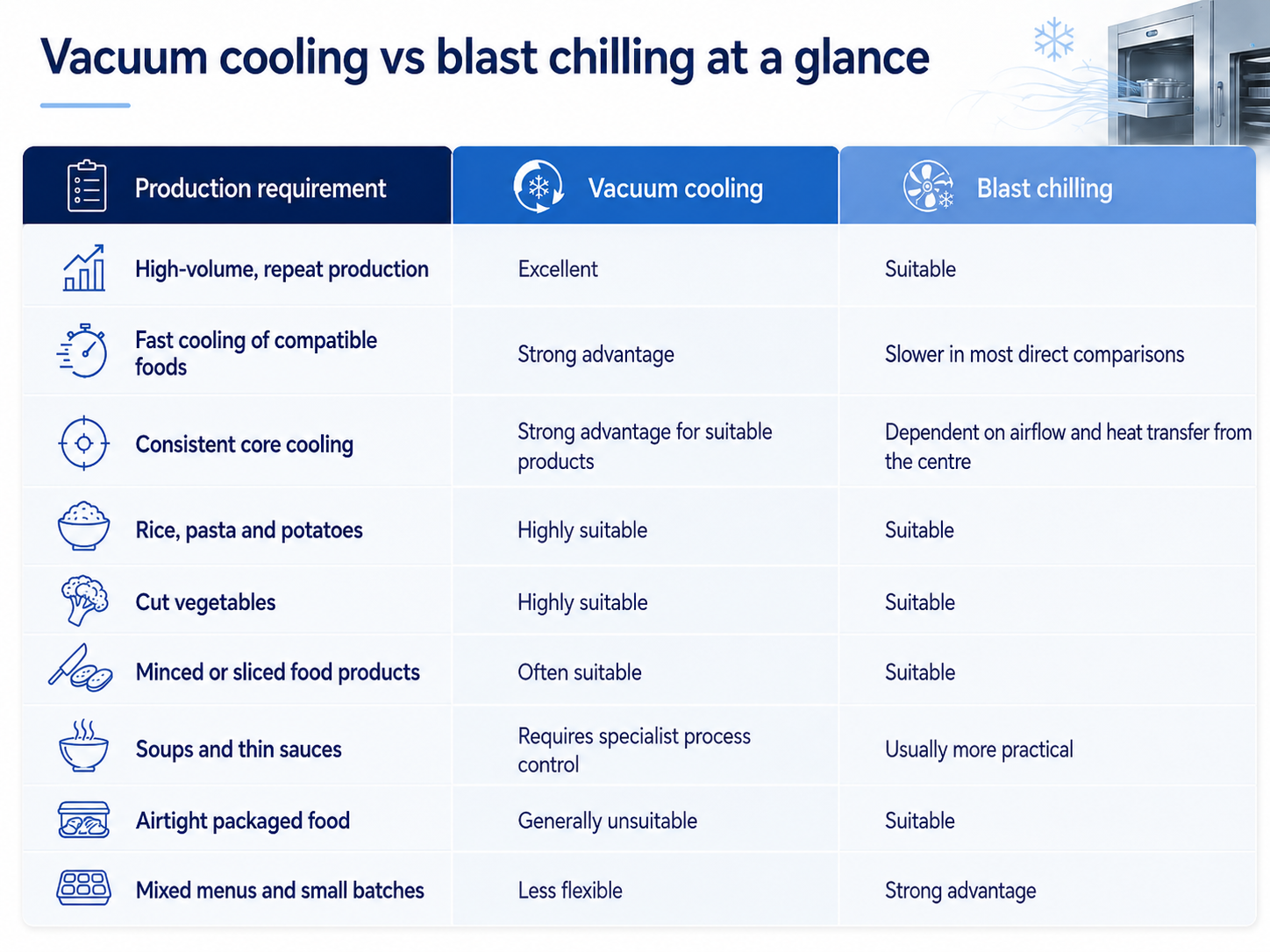
Vacuum cooling vs blast chilling at a glance
Production requirement Vacuum cooling Blast chilling High-volume, repeat production Excellent Suitable Fast cooling of compatible foods Strong advantage Slower in most direct comparisons Consistent core cooling Strong advantage for suitable products Dependent on airflow and heat transfer from the centre Rice, pasta and potatoes Highly suitable Suitable Cut vegetables Highly suitable Suitable Minced or sliced food products Often suitable Suitable Soups and thin sauces Requires specialist process control Usually more practical Airtight packaged food Generally unsuitable Suitable Mixed menus and small batches Less flexible Strong advantage Cooling-space reduction Strong potential More chamber capacity may be required Moisture management Must be controlled Usually less direct evaporative loss
Why cooling becomes a production bottleneck
Industrial cooking equipment can produce large quantities of food quickly. Cooling often struggles to keep pace.
A kettle, oven or cooking line may complete another batch while the previous batch is still waiting to reach its required packing or storage temperature. This creates queues of trolleys, occupies valuable floor space and delays the next production step.
For an industrial food producer, cooling is therefore more than a food-safety requirement. It directly affects:
- Kilograms produced per hour.
- Number of batches completed per shift.
- Trolley and tray availability.
- Labour planning.
- Packing schedules.
- Cooling-room capacity.
- Total production space.
The best cooling technology is the one that reaches the required product temperature safely, consistently and without slowing down the rest of the factory.

How does blast chilling work?
A blast chiller circulates very cold air at high speed around trays or containers of hot food.
The air first removes heat from the product’s surface. Heat from the warmer centre must then travel towards the colder surface before it can be removed.
Blast chilling is much faster and more controlled than allowing food to cool in a normal cold room. However, the process is affected by several operational factors:
- Product thickness and density.
- Container depth.
- Distance between trays.
- Air circulation around the load.
- Trolley configuration.
- Total batch weight.
- Product position inside the chamber.
For dense foods or deep containers, the centre of the product normally determines the total cooling time. The exposed surface may already be cold while the core is still releasing heat.
This is why blast-chiller loading patterns, tray depths and temperature-probe positions must be carefully controlled.

How does vacuum cooling work?
Vacuum cooling uses controlled pressure reduction rather than high-velocity cold air.
The hot food is placed inside a sealed vacuum chamber. Vacuum pumps then reduce the air pressure inside the chamber. As the pressure falls, the boiling point of water also falls.
A small amount of the moisture within the food begins to evaporate at a lower temperature. Evaporation requires energy, and this energy is taken from the food as heat. The product temperature therefore falls rapidly.
The generated water vapour is removed from the chamber and condensed by the cooling system. Once the required temperature and pressure profile have been reached, the chamber returns to normal atmospheric pressure and the cooled load can be removed.
Because the process uses moisture evaporation from the available product surface and internal structure, it is not completely dependent on cold air reaching the outside of every food portion. This is the main reason vacuum cooling can be significantly faster for moist, open and porous products.
Where vacuum cooling outperforms blast chilling
1. Faster cooling
Speed is the clearest advantage.
In an independent study comparing vacuum cooling, air-blast cooling, plate cooling and cold-room cooling for cooked rice, vacuum cooling produced the shortest cooling time. The researchers concluded that vacuum cooling was an efficient and suitable method for cooked rice, although moisture loss had to be managed.
A separate study comparing different cooling methods for cooked rice recorded a vacuum-cooling time of approximately 7.8 minutes. Under the tested conditions, the air-blast cycles took approximately 20 to 40 minutes, depending on the air temperature. These figures apply to the specific laboratory equipment and loads used in the study, but they demonstrate the underlying speed difference.
Research involving cooked broccoli and carrot slices also found vacuum cooling to be the fastest of the four methods tested. Average vacuum-cooling times were approximately 12 minutes for broccoli and 7.8 minutes for carrot slices, compared with a shortest conventional cooling time of approximately 44 minutes.
Weber’s published WeFood range is designed for cooling cycles of approximately 10 to 30 minutes, depending on the food, batch size, starting temperature and required final temperature. The standard range can accommodate up to four racks and 400 kg. Actual performance must always be confirmed with the customer’s product and production conditions.
2. More consistent cooling throughout the product
Blast chilling removes heat from the outside towards the centre. Vacuum cooling can remove heat through evaporation across a much larger available product area.
For suitable products, this can reduce the temperature difference between the surface and the core. Research comparing vacuum and air cooling of cooked chicken breasts found vacuum cooling to be approximately three times faster and reported a more homogeneous temperature distribution under the tested conditions.
This is especially valuable when a complete trolley must reach a defined target temperature before it can move to packing or cold storage.
Consistent cooling can help reduce:
- Loads held back because one tray remains too warm.
- Repeated manual temperature checks.
- Surface overcooling while waiting for the centre.
- Variation between trolley positions.
- Uncertainty in production planning.
No cooling system removes the need for validation. Core temperatures must still be measured using calibrated equipment and a documented loading configuration.
3. Higher production throughput
A shorter cooling cycle does more than save time. It changes the capacity of the entire production line.
Suppose a cooking department completes a batch every 20 minutes, but the cooling process takes more than one hour. Several batches must wait or cool simultaneously. The factory then requires more trolleys, more holding space and more cooling capacity.
When cooling is reduced to minutes, the cooling stage can operate closer to the speed of the cooking stage.
This can provide:
- More cooling cycles per shift.
- Faster transfer from cooking to packing.
- Less work in progress.
- Faster return of trolleys and containers.
- Better use of existing factory space.
- More production without extending the building.
For many industrial kitchens, this operational benefit is more important than the cooling time on its own.
4. Less cooling space
A long cooling cycle requires space for both the equipment and the products waiting to enter or leave it.
Because a vacuum cooler can process compatible products quickly, fewer batches need to be held in the cooling area at the same time. The same chamber may also complete more cycles during a production shift.
The possible space reduction depends on the existing production flow, but it should be included in any investment calculation. Floor space, trolley queues and work-in-progress inventory all carry a cost.
5. Better alignment with repeatable industrial production
Blast chilling is flexible. Vacuum cooling is powerful when the production process is repeatable.
It is particularly attractive when a factory produces:
- The same product families every day.
- Large and predictable batch sizes.
- Several hot batches per hour.
- Products with similar starting and target temperatures.
- Products that can release water vapour effectively.
These conditions are common in airline catering, central kitchens, sushi production, ready-meal factories and high-volume contract catering.
Which foods are suitable for vacuum cooling?
Vacuum cooling works best when the food contains available moisture and water vapour can escape through its surface.
Strong potential applications include:
- Cooked rice.
- Sushi rice.
- Pasta and noodles.
- Potatoes.
- Cut or cooked vegetables.
- Minced or sliced meat products.
- Falafel and selected fried products.
- Selected pastry and bakery products.
- Open trays of compatible meal components.
Smaller individual food pieces generally cool more easily than large, dense portions because they provide more available surface area relative to their mass.
Weber’s food-cooling materials identify rice, pasta, potatoes, cut vegetables and sliced or minced products as strong candidates for vacuum cooling. They also explain that suitability must be assessed individually because recipe, structure, loading method and moisture availability all affect performance.

Does vacuum cooling cause moisture loss?
Yes. Moisture evaporation is the mechanism that creates the cooling effect.
The amount of weight loss depends on:
- The required temperature reduction.
- Product surface area and porosity.
- Recipe composition.
- Pressure-reduction profile.
- Final pressure.
- Cycle duration.
- Whether additional water is used.
Moisture loss must therefore be measured during every product trial. It should not be assumed that one result will apply to every recipe.
Several control methods are available, depending on the food:
- Adjusting the recipe’s initial water content.
- Applying controlled water spraying.
- Optimising the pressure curve.
- Avoiding unnecessarily low final pressures.
- Adjusting batch depth or portion size.
- Using specialist immersion or assisted-vacuum processes.
In the cooked-vegetable study, water spraying substantially reduced weight loss and produced quality results comparable with the other cooling methods tested. Research on cooked rice also found that water spraying could increase the moisture content of vacuum-cooled rice without significantly extending the cooling time.
The commercial question is not whether evaporation takes place. It is whether the optimised product remains within its required yield, texture, appearance and portion-weight specification.

Is vacuum cooling more energy-efficient?
Energy claims should be based on measured factory data, not assumptions.
Actual consumption depends on:
- Batch size.
- Equipment utilisation.
- Starting and target temperatures.
- Vacuum-pump efficiency.
- Condenser and refrigeration design.
- Number of cycles per shift.
- Partial or full loading.
- Ambient operating conditions.
Shorter cooling cycles can reduce operating time and increase output per machine. However, the correct comparison is total energy per kilogram of accepted cooled product.
One lifecycle study involving cooked rice found that vacuum cooling had a lower calculated carbon footprint than the air-blast configurations tested, but not lower than every cooling method included in the study. The research also found that equipment efficiency and load utilisation had a major effect on the final result.
For an investment decision, measure:
Total cooling energy ÷ kilograms of saleable product
This is more useful than comparing installed motor power or one demonstration cycle.
How should production managers compare the two systems?
Do not compare vacuum cooling and blast chilling only by purchase price.
Evaluate the complete production cost:
| Measurement | Why it matters |
|---|---|
| Kilograms per load | Defines usable batch capacity |
| Cooling time | Determines cycles per shift |
| Core-temperature variation | Indicates process consistency |
| Weight loss | Affects saleable yield |
| Energy per kilogram | Shows real operating efficiency |
| Labour per batch | Identifies handling requirements |
| Floor-space requirement | Reveals the value of occupied production space |
| Trolleys required | Measures work-in-progress cost |
| Product quality after storage | Confirms commercial acceptability |
| Maintenance requirement | Affects availability and lifecycle cost |
The best solution is the one that delivers the required quantity and product quality at the lowest total cost per accepted kilogram.
The verdict: which cooling technology wins?
For a small kitchen producing soups, sauces, sealed packs and a constantly changing menu, blast chilling is likely to remain the more flexible choice.
For an industrial kitchen or food factory producing large, repeatable batches of suitable cooked products, vacuum cooling is the stronger production technology.
It offers clear potential for:
- Substantially shorter cooling cycles.
- More consistent product temperatures.
- Higher output from the available cooling area.
- Less work in progress.
- Faster return of racks and trolleys.
- Better alignment between cooking and packing.
- Greater control over production planning.
Vacuum cooling should not be selected on the basis of a brochure claim alone. The process must be tested with the real product, real recipe, full batch load and required target temperature.
But when the product is suitable and cooling is restricting production, vacuum cooling does more than replace a blast chiller.
It removes the cooling bottleneck.
Is your product suitable for vacuum cooling?
Every product behaves differently under vacuum.
To assess your application, Weber Vacuum Group will need:
- Product type and recipe.
- Batch weight.
- Starting temperature.
- Required final temperature.
- Current cooling method.
- Current cooling time.
- Trolley, tray or container dimensions.
- Required production capacity per hour or shift.
Based on this information, Weber can assess product suitability and define the correct testing procedure.
Contact Weber Vacuum Group to discuss your food-cooling application.
Frequently asked questions
Is vacuum cooling faster than blast chilling?
For suitable moist, open and porous foods, vacuum cooling is normally faster because cooling takes place through evaporation under reduced pressure instead of relying only on cold air to remove heat from the product’s surface. The precise difference depends on the food, load and equipment.
Can vacuum cooling replace every blast chiller?
No. Blast chilling remains more suitable for many liquids, airtight packages, low-moisture products and kitchens producing small quantities of many different foods.
Does vacuum cooling cool food to the core?
Vacuum cooling can provide a more even temperature distribution in suitable foods because evaporation can take place across the available product surface and internal structure. Core-temperature performance must still be validated for each recipe and loading configuration.
Does vacuum cooling dry out food?
Some moisture evaporation is unavoidable because it creates the cooling effect. Product trials are used to optimise pressure, cycle time and recipe moisture so that the finished product remains within its required yield and quality specifications.
Can vacuum cooling be used for cooked rice?
Yes. Cooked rice is one of the strongest applications for vacuum cooling. Independent research has found vacuum cooling to be substantially faster than blast, plate and cold-room cooling for cooked rice, although moisture and texture must be controlled through the selected process.
How long does industrial vacuum cooling take?
Cycle time depends on the food, load, starting temperature and target temperature. Weber publishes typical WeFood cooling cycles of approximately 10 to 30 minutes. Product testing is required before a guaranteed process specification can be established.